Xinyu (Rain) Wei 魏昕雨

I am a quantitative analyst at Capula Investment Management. I received my B.S. in Computer Science from Columbia University in 2024, summa cum laude. At Columbia, I was fortunate to be advised by John Wright, Kaizheng Wang, and Garud Iyengar.

I am interested in the principles that explain how learning systems work, where they fall short, and how that understanding can lead to better methods and useful technologies. My research spans neural-network training dynamics, learning on low-dimensional manifolds, adaptive statistical estimation, and decision-focused optimization. I aim to connect theoretical insight with practical systems that make knowledge and capabilities more accessible.

I grew up in Hebei, China, moved to Sydney at 15, and later moved to New York for college and work. I am currently living and working in London. Outside work and research, I am a professional Latin dancer.

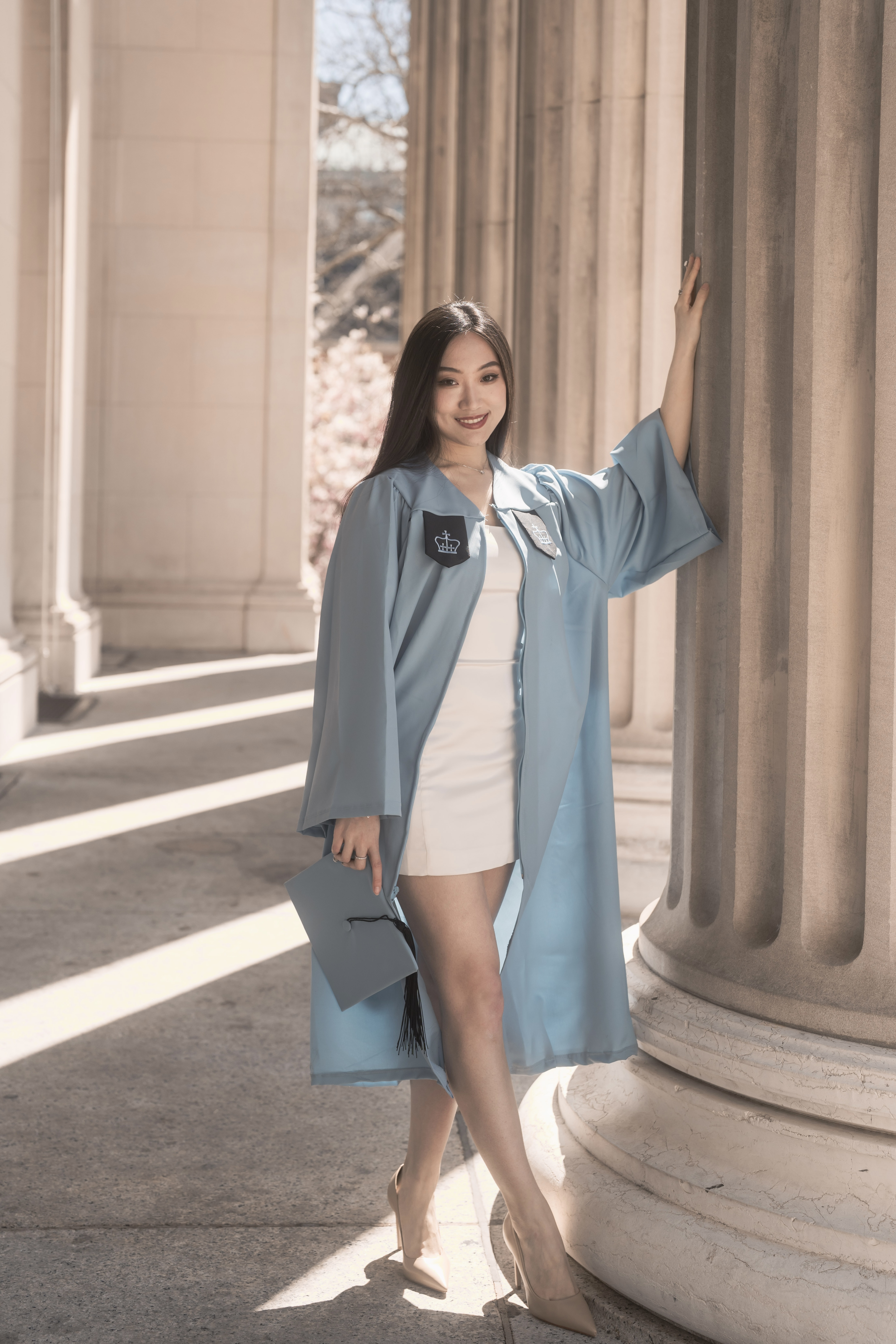
Xinyu Rain Wei in Columbia graduation attire

Research

TpopT: Efficient Trainable Template Optimization on Low-Dimensional Manifolds

J. Yan, S. Wang, X. R. Wei, J. Wang, Z. Márka, S. Márka, and J. Wright

TpopT replaces exhaustive template-bank search with trainable optimization on a low-dimensional signal manifold. I led the core theoretical analysis, establishing curvature-dependent convergence guarantees for Riemannian gradient descent under Gaussian noise and estimation bounds governed primarily by intrinsic dimension. The analysis identifies the geometric conditions behind its computational advantage over matched filtering and the limits of that advantage.

Neural Network Theory: Training Dynamics and the Neural Tangent Kernel

T. Wang, X. R. Wei, and J. Wright

How can we explain neural-network training as the network’s internal features change? We studied finite-width ReLU networks learning to classify data on low-dimensional manifolds. The neural tangent kernel (NTK) describes how parameter updates change predictions; approximating it by its value at initialization simplifies analysis but can impose restrictive conditions on network width and parameter movement.

Our approach investigates a time-dependent approximate NTK evaluated along a tractable proxy for the weight trajectory. The objective is to compare this approximation with the trained network and understand when useful kernel structure persists as features evolve.

I developed components of this framework, deriving forward-feature perturbation bounds and analyzing Gaussian small-ball estimates and changes in ReLU activation patterns. These calculations address how parameter movement changes intermediate representations and which neurons switch between active and inactive states—key steps in comparing the evolving kernels. In a related study of learning from noisy manifold observations, I contributed proofs involving local manifold geometry, smooth-function approximation, and small-norm kernel certificates, which connect the learning target to the kernel’s action.

This was my most sustained undergraduate research effort. The work produced intermediate theoretical analyses toward a broader convergence result; the full convergence theorem remains open.

Adaptive Statistical Estimation and Multi-Task Learning

Research with Kaizheng Wang

I studied Gaussian multi-task estimation to characterize when pooling related tasks improves on separate estimation, deriving the bias–variance tradeoff and the role of task heterogeneity. In related work, I derived K-fold cross-validation estimators for regularized Gaussian mean estimation and evaluated their risk against maximum-likelihood, Bayesian, and oracle benchmarks using analytical calculations and Monte Carlo experiments.

End-to-End Variational Inference for Robust Portfolio Construction

X. R. Wei, G. Costa, and G. N. Iyengar

This work integrates a variational inference neural network with a Monte Carlo-based portfolio-optimization layer, training the predictive distribution using both statistical and downstream task losses. I derived gradient expressions using KKT-based implicit differentiation and contributed to the PyTorch implementation and synthetic-data experiments evaluating decision quality.

Patent

Professional experience

Capula Investment Management

I develop quantitative models and computational systems for investment research. My work includes redesigning volatility-surface calculations through tensorization and parallel computation, and developing an optimization framework for allocating trades across execution days. I focus on identifying computational bottlenecks and turning mathematical methods into tools used in daily workflows.

Education

Columbia University

Summa cum laude · GPA: 4.092

Bonomi Research Scholar (2023); Electrical Engineering Summer Research Grant (2023); Columbia Math Undergraduate Summer Research Fellowship (2022); Mathematical Modeling Research Grant (2021). Honor societies: Tau Beta Pi and Upsilon Pi Epsilon.

Courses taken

Meriden School

ATAR: 99.95 —  highest rank in Australia. HSC All-Round Achiever and Distinguished Achiever; High Distinction in the Australian Physics and Chemistry Olympiads (2018).

Teaching

Columbia University

Led office hours and assessed coursework for:

  • Machine Learning — COMS 4771
  • Computer Science Theory — COMS 3261
  • Discrete Mathematics — COMS 3203

Beyond research

Entrepreneurship

Axon

An independent AI project exploring how to elicit expert decision rationales and represent evolving assumptions and judgments, with the aim of making tacit knowledge easier to articulate and share. Co-founder and CTO.

Elite Youth Education

An international education company providing tutoring and academic support through a team of more than 70 tutors and staff. Founder and CEO.

Professional ballroom dance

International Latin Dance

I have trained professionally in International Latin dance since the age of four. I compete internationally and teach private and group lessons.

International and national competition results include a semifinal at The Open Worlds Latin Solo (2026), 3rd place in The Open Worlds Latin A (2025), and finalist titles at the United States Dance Championship, King’s Ball, and Emerald Ball. 

Competition awards · Dance photo library